No Stranger To Doggy Danger
“Dad!”
“Dad!”
"Daaaaaaaaad!”
My daughter, who was visiting from DC, was shouting up to my office from the bottom of the stairs. She knew I was working, and I knew whatever was up, it was serious.
“What is it?”
“You’d better come down here! It’s Dash!”
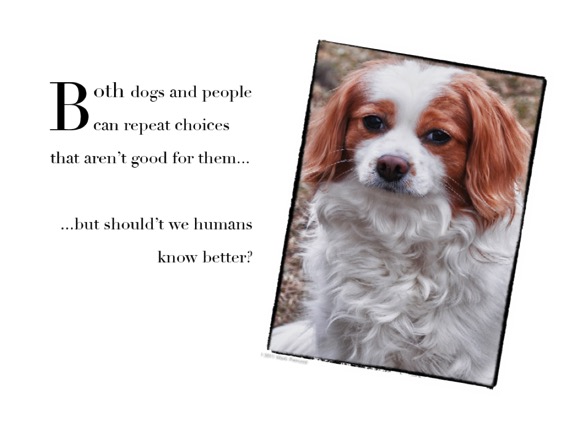
Dash is the smallest of our two dogs. He's a pomeranian/King Charles spaniel mix (and the ladies love him).
If it’s a Dash emergency, it usually means he’s eaten something wrong, and in this case, it was very wrong.
“On my way!” I shouted, leaving a half-finished email, and nearly tumbling down the stairs, while preparing for the worst.
As I rounded the corner at the bottom of the stairwell, my daughter held out 5 ounces of what was 8 ounces of primo, ultra-dark, handmade chocolate that I had bought for her.
“It was on my backpack on the chair next to me. Next thing I know, Dash is eating it under the table. He must of reached up for it and pulled it down…”
Of course, as I hinted earlier, this was not the first time that Dash had eaten something wrong for him.
Faced with the latest Dash adventure, I remembered the backyard mushroom incident, which resulted in far too much… stuff… from both ends of the dog, and an overnight in emergency care. I remembered the endless plastic toys, wood chips, and—let's just call them remnants of our cat's hunting—which he regularly tried to make a part of his diet.
I knew I had to call poison control.
Three veterinary poison control phone calls, $65, and two doses of fresh hydrogen peroxide later, Dash gave up the chocolate to the back yard, and he was out of immediate danger.
But would he do it all again in spite of the trauma he just went through?
You bet he would. In fact, he tried to eat back the chocolate almost as soon as he gave it up. (Gross!)
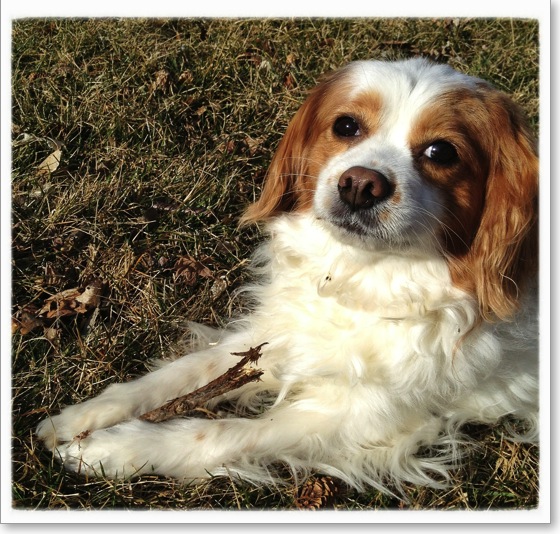
Here’s Dash enjoying a spruce twig (before I took it away from him) just days after the chocolate debacle….
In between Dash's forbidden food incidents we joke that, "He just can't help himself." And don't we all know someone that we can say that about? Haven't we all said it at least once about ourselves regarding some area of our lives?
The funny thing is, Dash has an excuse. He's not self-aware. He doesn't chide himself for eating the chocolate. He doesn't look at the experience and ask, "how can I do better next time." He's not capable of deciding when to go for it, or when to deny himself a simple, immediate pleasure now, because it is in the highest interest of his future. He doesn't know that giving up something now can often help him get something he values even more, later… like, say, staying alive.
We humans, on the other hand, should know better, right? We are self-aware. We can see the benefits of choosing wisely now, so that we benefit later. We can trade the moment's promise of pleasure for long-term greater happiness.
Or can we?
It's true that we all have the workings—a kind of inner guidance system or compass—that we can steer by. Still, too often, we're more like sailors who are winging it, not even glancing at our available navigation instruments, and pretty much on a random course—just like our friend Dash. A few months ago, I had a thirty-something shaking his head in one of my workshops, marveling that it had been literally years since he had thought about what he wanted!
Most of the time we're not intentionally ignoring our feedback and guidance systems. Most of the time the issue is that our attention is pulled away from our inner compass by daily responsibility, stress and custom (that's right, custom). Once separated from that guidance, it's all to easy for us to head for a mirage of comfort in something that might not contribute to our long-term wellbeing.
It doesn't have to go that way. We can "check in" with ourselves more often. We can develop habits that support checking-in, and bring focus back to our built-in guidance system. Once we do this, the combination of our attention, and our internal compass make for a "smart GPS": we decide what we want and why we want it, and our guidance system locks in and keep us on course… that is, if we are paying attention.
Here are some tips for tuning into our guidance system…
Make a list of the top ten improvements you want in your life.
Given thirty-seconds, most of my clients can't write more than a handful of improvements they want most, and some can't get past two or three in that amount of time. If you can't write ten things you want to improve in your life in thirty-seconds, you aren't thinking about what you want often enough. How can your guidance system guide you some place if you don't know where it is? Make sure that everything you list, including being of service to others, is your choice. Make the list and revisit it at least twice weekly. Revise as necessary.
Go back to the list and make a list of why you want each one.
Knowing why we want what we want is incredibly important. It helps us tune-in to what it is that really motivates us, and… what doesn't. If you can't tie a "want" to a personal "why" you aren't all that motivated in the direction of that desire. Doing it because someone else says its healthy or the right thing to do won't cut it—at least not for the long term. You have to have your very own, personal reason to “go for it.”
Create reminders of where you want to go, and have them available at hand, or in places where you are likely to go astray of your direction.
I have clients who carry a small stone in their pocket, or wear a particular charm on their bracelets to remind them of where they want to go. Some use "vision boards"—shadow boxes or cork-boards covered with visual representations of what they want. Some put reminders on refrigerators, bathroom mirrors, and/or somewhere in their office space. I use technology to my advantage, setting regular reminders on my iPhone to "check-in" during the day: "Are you getting done what you want done?"; "Have you taken moment to appreciate what you've accomplished so far?"; "How are you doing on your book?" etc.
Get in the habit of asking important questions at "choice points."
Is what I'm planning in my highest interest?
Will what I’m planning to do contribute to my long-term happiness?
What is my intent here?
Why am I paying so much attention to this?
What am I trying to avoid by taking this direction, instead of working through what's holding me back from what I really want?
These are examples of questions we can use before making important decisions like: going into a meeting to make our boss wrong; disciplining our kids; eating something with 5,000 milligrams of sodium; or going after our spouse about how he or she squeezes the toothpaste tube. All kidding aside, the point is to check-in and get conscious about our choices. The best questions will point to the bigger question: "What am I really trying to do here, and is it really lined up with what I ultimately want?"
What do I want more, another slice of slice of pie, or to maintain a 32" waist? (Sure, I would like both, but unlike Dash, I know better.)
Take time to meditate, stretch, walk during the day.
Learn one or more breathing, meditation, or other attentional training practice that you can do during the day. In my workshops, I usually teach two or three, including a relaxation technique that anyone can do even during a business meeting, without anyone else the wiser as to what's going on. For those of us that like to move, there are mindful walking and even running techniques, that combine attentional training with movement. This kind of activity gives us resilience, and increases our ability to be more present to the moments where we might go off course, or disregard our guidance system.
Do you check in enough during the day? What do you do to keep on track towards your shorter-term goals and long-term aspirations?
Oh, and let's not forget about our friend Dash. He's alive and well. He's no stranger to doggy danger. As a puppy, he was rescued from a pen in a local pet store by my wife, Sue. When we brought him home, we knew something was wrong. When my daughter noticed his nose running, we took him to the vet, only to find his list of ailments included giardia and pneumonia. Of course he fully recovered, and is now a very resilient, healthy pup. Chocolate? Ha, Dash scoffs at such minor risks. (But we don't, and will continue to protect him from himself for as long as he's with us.)